How I run product launches
I'm an interim product marketing manager for B2B SaaS companies, and I've run a lot of launches as a 3x founding PMM. This page is the process I've used with 10+ clients over the last two years, and the mistakes it's built to stop.
Note: I wrote this process before AI was a thing, but I still follow it exactly. I use Claude Code to automate my product marketing work, and it makes me 5x faster. I'm writing a separate article on how I use AI in my work.
Why I think a lot of product launches fail
I've seen the same four things go wrong again and again:
- Every release gets the same effort. The team treats a small fix like a big launch, so the launch that could move revenue gets half the attention.
- Nobody knows who the launch is for. The product ships into a crowded market before anyone has worked out which buyers need it.
- Product, sales and marketing tell different stories. Every rep pitches the product their own way, and the buyer hears a different product on every call.
- Nobody agrees what success looks like. The launch goes out, and three months later nobody can say if it worked.
The rest of this page is how I stop each one.
How I prioritize launches
Not all launches deserve equal love. One client had seven releases lined up for the same quarter, including a fix that had sat in beta for months without traction. I tiered them, and only two deserved a full launch. The rest were small updates, so they went into a quarterly update or stayed internal.
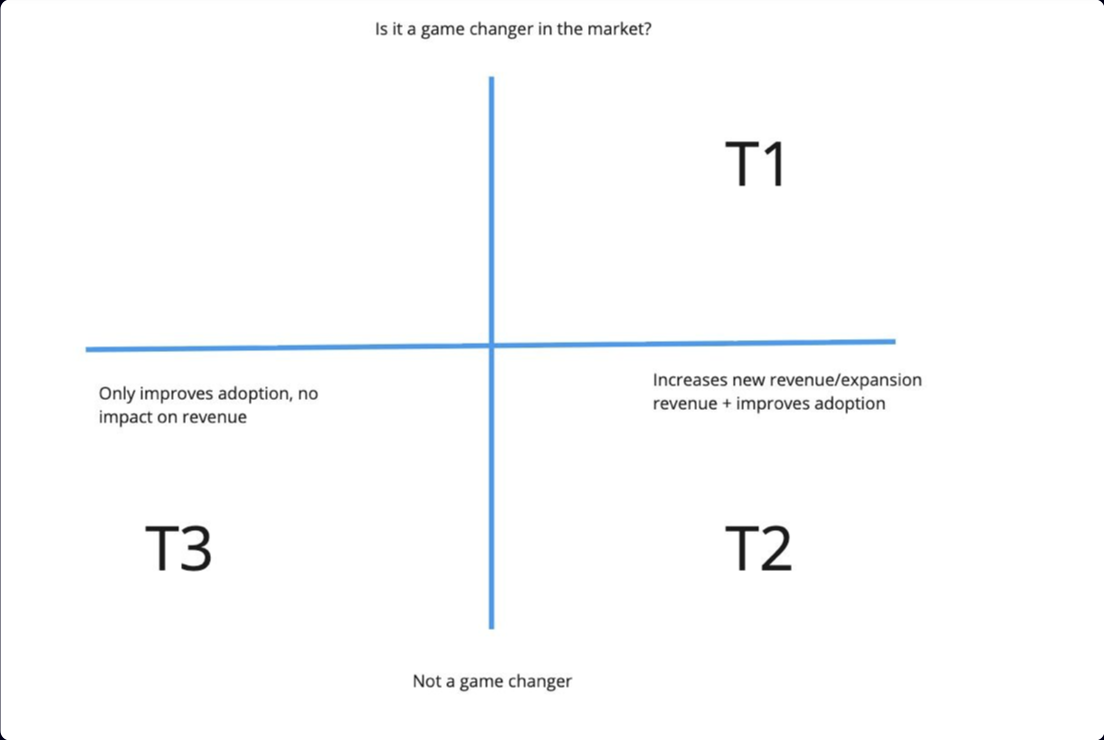
- T1: market-defining, full launch on every channel. It drives new or expansion revenue, and no competitor has it.
- T2: focused launch on a targeted set of channels. It drives new or expansion revenue, and competitors may have something similar.
- T3: lightweight, bundled into a quarterly update. It improves adoption with no direct revenue impact.
6 questions I answer before any launch
I answer these six questions with the team before I build anything:
- Why are we launching? The commercial goal (new revenue, upsell or adoption) and why now.
- What are we launching, and for who? The feature in one line, and the segment it's for.
- Who needs to know internally before anything goes public? Sales, CS, marketing and support.
- Who are we reaching externally? Existing customers, new-business prospects, or both.
- When are we going live? The four dates: product release, internal enablement, customer comms and public launch.
- Where are we launching? The channels, pulled from the tier.
The answers shape the positioning document, and every launch asset comes from it. I run 10 to 20 customer interviews before I write it, so the messaging uses the words customers use. The interviews I ran for a new AI notetaker showed its real buyers were European teams whose IT blocked US tools, and that finding changed the whole homepage.
How I pick channels for each tier
The tier I set in the first step decides the channels. A T1 launch gets the full channel stack, and a T3 launch stays lean.
| Channel | T1 | T2 | T3 |
|---|---|---|---|
| Release notes | ✅ | ✅ | ✅ |
| In-app message | ✅ | ✅ | ✅ |
| Help articles | ✅ | ✅ | ✅ |
| ✅ | ✅ | ✅ | |
| Webinar | ✅ | ✅ | |
| Landing pages and blogs | ✅ | ✅ | |
| Social media | ✅ | ✅ | |
| Paid ads | ✅ | ✅ | |
| Video | ✅ | ||
| Press release | ✅ |
How I keep teams aligned
Every launch needs one person who owns it, or each team ends up telling its own story. A payments platform I worked with had exactly this problem: every rep had built their own deck. I now walk the 6 or 7 launch leads through the positioning document and the plan on every launch, announce the launch to the whole company, and run check-ins with each team around their existing processes.
| Team | What they care about | What I do with them |
|---|---|---|
| Product | Feature adoption | Agree the launch plan early and turn feature specs into customer-facing language. Review adoption data together after launch and agree the next steps. |
| Sales and CS | New and expansion revenue | Give reps the story, the sales deck and the talk track before launch day, then run a sales enablement session. Work with CS to drive adoption in existing accounts. |
| Marketing | Pipeline and demos | Agree campaign goals and the audience before anything is briefed, and share the messaging so every channel says the same thing. |
How I measure success
I lock in four things with the team before every launch: the goal, the metric this launch can move, the baseline and the target. I track the metric after launch and share what moved with the team.
| Goal | Metric | Baseline (example) | Target (example) |
|---|---|---|---|
| Adoption | Accounts using the feature | 18% | 30% |
| New revenue | New pipeline from the launch | €0 | €100k |
| Expansion | Expansion revenue | €50k | €120k |
Results from launches I've run
- 55 follow-up meetings at one conference, after I rebuilt a payments platform's story (read the case study)
- Two major launches and three smaller ones that I ran while a company's PMM seat was empty (read the case study)
- 125 business sign-ups in two months for a new AI notetaker, about 40% from ChatGPT and Gemini (read the case study)
- 17% → 31% feature adoption across 44,000 users
Questions VPs of Marketing ask me
How fast can you get up to speed on our product?
I learned new products and markets from scratch several times as a founding PMM, and I use AI to work through customer calls, reviews and competitor research, so research that usually takes weeks takes days.
How soon can you join?
I can usually start straight away, depending on how many clients I'm working with at the time, so ask me and I'll give you the earliest date.
Do we need to hire a PMM, or can you run our launches?
I can run one or two launches as a single project, or over a few months if more are coming. If you have a steady stream of launches, a PMM hire makes sense, and I can run your launches while you hire, so the new hire starts with a launch process that already works.
Message me on LinkedIn if a launch is coming up and nobody owns it.
 Talk to Gokul →